Blog
Stockholm Water Prize 2026

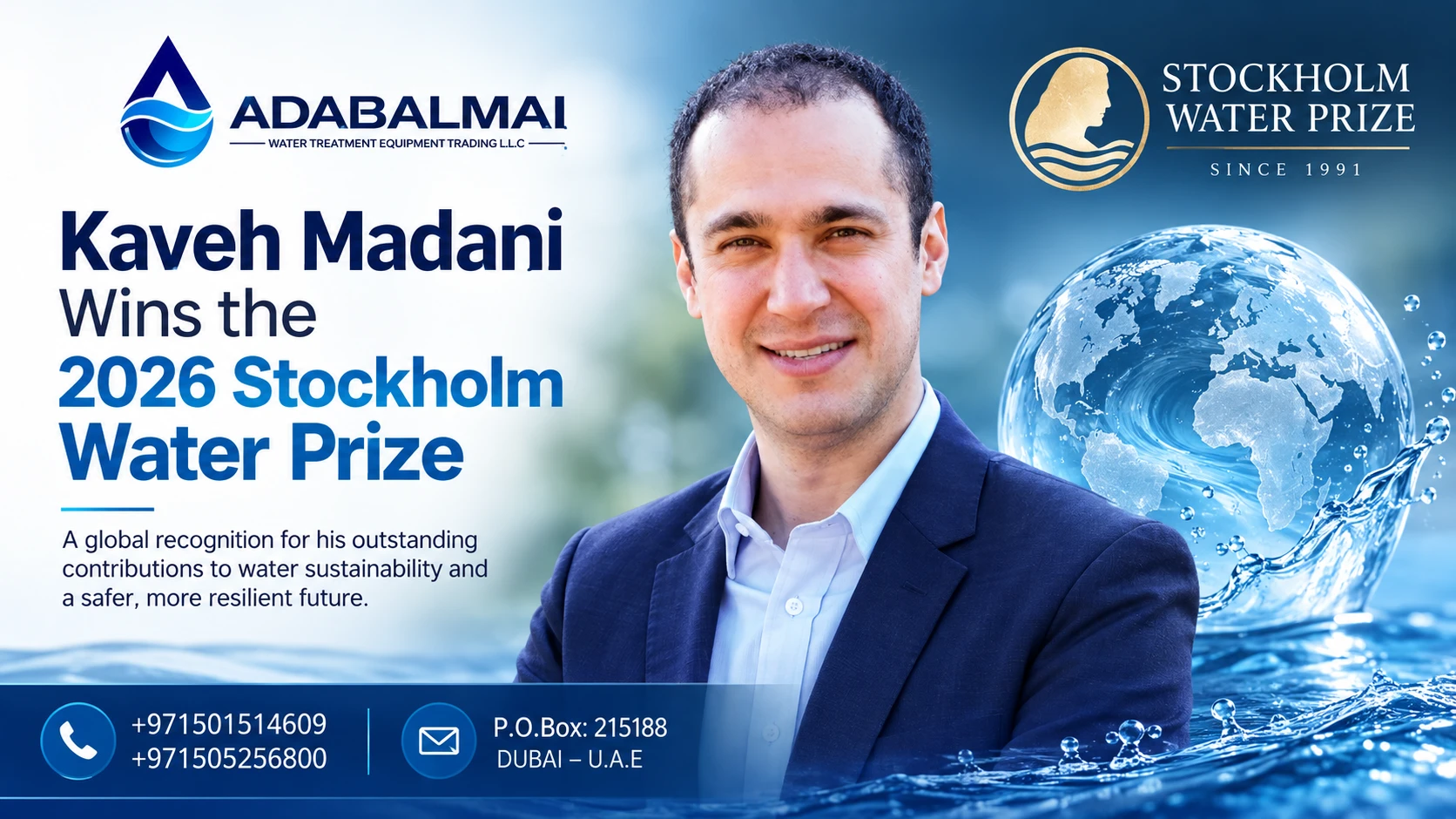
Kaveh Madani Wins the 2026 Stockholm Water Prize: A Wake-Up Call for the Middle East’s Water Future
Every year, the Stockholm Water Foundation and the Royal Swedish Academy of Sciences hand out an award so respected within the water sector that it has earned an unofficial nickname: the “Nobel Prize of Water.” In March 2026, that honor went to an Iranian-born scientist whose research speaks directly to the challenges facing Dubai, the wider UAE, and the entire Gulf region — Professor Kaveh Madani.
For a business like Adab Al Maa, which works every day to help homes, buildings, and industries in the UAE access clean, reliable water through advanced purification technology, this announcement is more than just international news. It is a validation of exactly the mission we’ve been pursuing: treating water not as an unlimited resource, but as a precious asset that requires smarter management, better technology, and long-term thinking.
Who Is Kaveh Madani? Kaveh Madani Wins the 2026 Stockholm Water Prize
Kaveh Madani currently directs the United Nations University Institute for Water, Environment and Health (UNU-INWEH) and holds a research professorship at the City College of New York. Earlier in his career, he served as Iran’s Deputy Vice President for the Department of Environment, where he pushed for greater transparency in national water governance. At 44 years old, he became the youngest laureate in the 35-year history of the Stockholm Water Prize, and the first sitting or former UN official to receive it.
Madani’s award recognizes his pioneering research combining game theory and decision-making analysis with water resource management, along with a concept he helped popularize that is now shaping how governments and scientists talk about the global water crisis: water bankruptcy.
What Is “Water Bankruptcy,” and Why Does It Matter in the Gulf?
Madani’s water bankruptcy framework describes a situation where a river basin, aquifer, or water system has been drawn down so heavily and for so long that it can no longer recover to its historical, sustainable state — even if consumption were reduced. In a United Nations report published in January 2026, he warned that many of the world’s major water systems have already crossed this threshold.
This idea resonates strongly across arid and semi-arid regions, including the UAE, where natural freshwater resources are extremely limited and most of the water supply depends on energy-intensive desalination and carefully managed groundwater reserves. The lesson from Madani’s research is clear: growth, industry, and daily life cannot depend indefinitely on drawing down finite reserves. Long-term water security requires treatment, purification, and reuse strategies that reduce pressure on primary sources.
The UAE’s Position in the Global Water Conversation
The UAE has already positioned itself as a regional leader in desalination technology and water infrastructure investment, but rising demand from population growth, industry, and agriculture continues to test the limits of supply. Middle Eastern desalination capacity has expanded rapidly in recent years, yet experts continue to flag serious water stress across the region as a long-term risk to be managed proactively rather than reactively.
This is precisely where purification technology — including reverse osmosis (RO) membranes, industrial filtration systems, and water reuse solutions — plays a central role. Every liter of water that is treated, reclaimed, or reused through modern purification systems is a liter that doesn’t have to be pulled fresh from an already-strained source.
Why This Prize Matters for Adab Al Maa’s Work
At Adab Al Maa, our focus on RO membrane systems, filtration technology, and water treatment maintenance for the Dubai and UAE market is grounded in the same principle Madani’s award now brings to global attention: water infrastructure has to be built and maintained with sustainability in mind, not simply capacity.
A few practical takeaways from Madani’s research map directly onto smart water management for homes and businesses in the region:
- Preventive maintenance matters. RO membranes and filtration systems that are properly maintained last longer, waste less water through inefficient rejection rates, and reduce the strain on primary supply.
- Water reuse is not optional — it’s strategic. Whether in industrial facilities or residential buildings, recovering and reusing treated water reduces dependence on desalinated or trucked-in supply.
- Quality monitoring protects long-term supply. Understanding water chemistry, mineral content, and system performance helps prevent the kind of long-term degradation Madani describes as water bankruptcy.
A Global Spotlight, A Local Responsibility
Madani is set to formally receive the Stockholm Water Prize from King Carl XVI Gustaf of Sweden in August 2026, during World Water Week in Stockholm. But the significance of his work doesn’t wait for a ceremony — it’s already shaping policy conversations from the UN to national governments across water-stressed regions, including the Gulf.
For residents, building managers, and industrial operators across the UAE, the message is simple: the choices made today about water treatment, filtration, and reuse determine whether tomorrow’s water systems remain resilient — or edge closer to the kind of irreversible strain Madani has spent his career warning about.
What is the Stockholm Water Prize? It is an annual international award presented by the Stockholm Water Foundation in collaboration with the Royal Swedish Academy of Sciences, recognizing outstanding contributions to the sustainable use and protection of the world’s water resources. It is widely referred to as the “Nobel Prize of Water.”
Who won the Stockholm Water Prize in 2026? Iranian scientist and UN official Kaveh Madani, director of the United Nations University Institute for Water, Environment and Health, won the 2026 prize — becoming the youngest laureate in the award’s history.
What is “water bankruptcy”? It’s a concept developed and popularized by Kaveh Madani describing water systems — rivers, aquifers, or basins — that have been depleted so severely they can no longer return to their historical, sustainable condition.
How does this relate to water purification in the UAE? The UAE relies heavily on desalination and managed groundwater due to limited natural freshwater. Concepts like water bankruptcy highlight why purification, filtration, and water reuse technologies are essential to reducing pressure on those limited primary sources.
When will Kaveh Madani officially receive the award? The prize will be formally presented by King Carl XVI Gustaf of Sweden during World Water Week in Stockholm in August 2026.